*** OVERVIEW ***
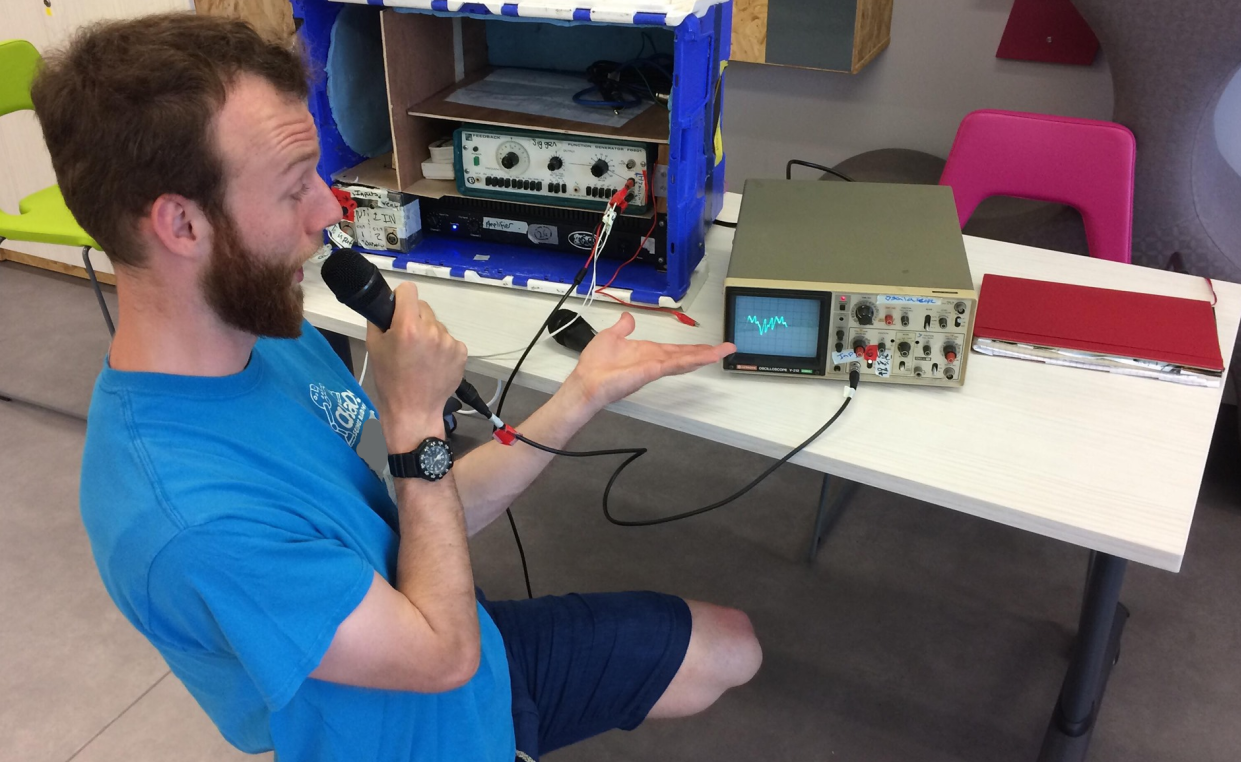
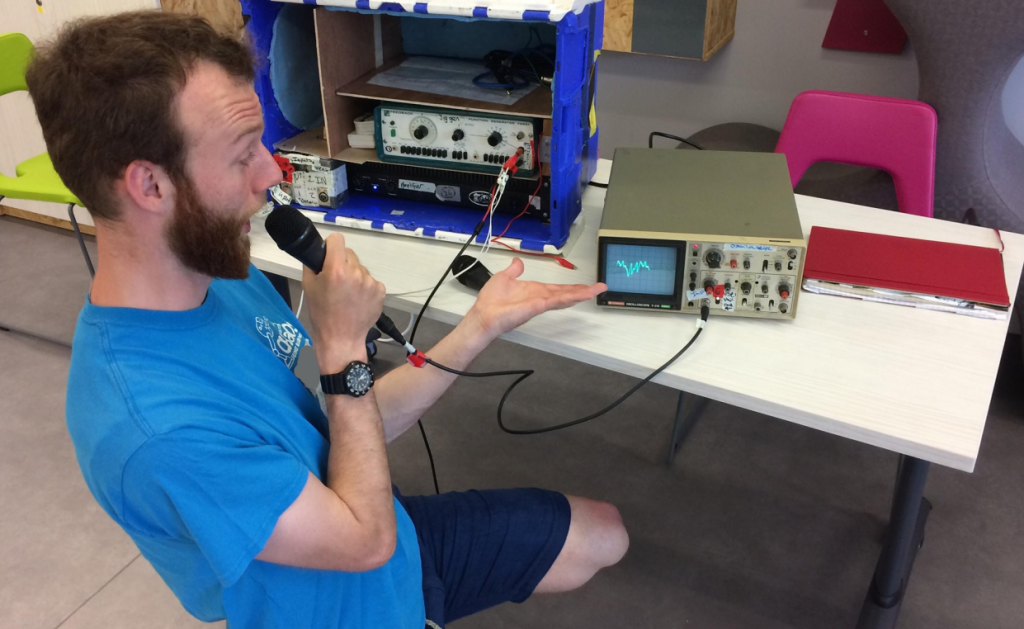
Seeing Sound uses a signal generator and loudspeaker to make sounds, as well as various musical instruments. There is a microphone and oscilloscope to `see' the sound, to allow kids to learn about what sound waves are and some of their properties.
Possible activities:
- Explaining what sound is, and how you can hear things, using the signal generator and loudspeaker.
- Looking at your voice on the oscilloscope when you say different words and vowels etc.
- Comparing the voices of different people looking at pitch and volume.
- Looking at how simple musical instruments work.
Other things to talk about:
- How sound travels through the air.
- How the oscilloscope displays a sound wave.
Tips for demonstrating:
- Get the whole family to talk into the microphone so that you can look at the different pitches and volumes of their voices.
- Get the children to try different vowel sounds, low sounds, and high sounds etc.
- There's a lot which can be done in this experiment; you don't have to do it all, and you don't have to follow the order below...
*** BASIC PROCEDURE AND EXPLANATION ***
- Start by explaining how we can hear things. Ask the children if they know anything about waves - water waves, sound waves etc.
- When sound travels through the air, it is in the form of a wave, a little bit like the waves that you get on the surface of water (although longitudinal compression wave rather than transverse).
- Use the slinky to show how longitudinal waves travel. Normally we can't see these waves in the air, but our ears can pick them up.
- Using the signal generator and amplifier, get the loudspeaker oscillating at 10-20 Hz and get the kids to notice this. If they are careful they can touch the speaker gently to feel it move.
- Then turn up the frequency so you can hear it (make the connection between the wobbling and the sound) and can still feel it 50-80Hz. Get them to feel the air above the speaker they should be able to feel it moving. Say that the air wobbles above the speaker, and then wobbles all the way to their ear (you could use the slinky to demonstrate this - a picture of an ear and loudspeaker may help here too) and your ear hears the wobbles as sound.
- Turn up the frequency again, and get the kids to make the connection between speed of vibration and pitch.
- Explain that you can't see sound, because the air is transparent and it's moving too fast anyway. Then introduce the microphone and oscilloscope and look at the sound from the loudspeaker. The children can also make some simple noises into the microphone. Vowels are good for this. Explain that each sound has its own particular shape - saying the alphabet can prove invaluable here. A long vowel sound should create a quite stable wave on the 'scope.
- Ask the child to sing a quiet note and a loud note, and see that the picture drawn gets taller with volume.
- Get child to sing a long note moving from a high note to a low note (dads may be useful here for very deep notes), and show that the wiggles on the screen get further apart the lower the note, and closer together the higher you go. This is a measure of increasing frequency - when things vibrate faster, we get a higher note (e.g. car accelerating).
- They can also feel their larynx vibrate when they talk - easier with lower sounds.
- Now for the musical instruments! Let them try to make different notes with recorder and concertina, and with the big pan pipes from the resonance experiment. Look at how different pitches, different volumes, and different timbres (types of note) appear on the oscilloscope.
*** OTHER THINGS TO TALK ABOUT ***
- Introduce the idea of wavelength with long wavelengths corresponding to low frequencies and vice versa.
- A couple of features of the oscilloscope can be explained. You can explain that the microphone converts the air wobbling into an electrical wobble which makes the dot on the screen wobble up and down (you can show this by turning the freq very low on the oscilloscope and you should be able to see the dot going up and down). Speed the dot up again a bit and kids can normally work out that fast wobbles make short wavelengths on the screen, and from stuff earlier they should be able to work out that high pitch makes short wavelengths too.
- You can go into more detail of the biology of hearing, or use this point to encourage them to go onto the biology experiments afterwards!
- You can think about why the ear and loudspeaker are the shapes they are, and why these are quite similar. This is also quite like an amphitheatre.
*** SCIENCE BACKGROUND FOR DEMONSTRATORS ***
Sound is a longitudinal (compression and rarefaction) wave through the air. The signal generator produces an oscillating electrical signal, made bigger by the amplifier; the loudspeaker contains a coil of wire which acts as an electromagnet, so that the speaker cone oscillates at the same rate as the signal. We hear because the sound wave makes our eardrums vibrate: the vibration is passed on through a series of bones which amplify its magnitude to the cochlea, where tiny hairs inside the fluid-filled tube pass a signal through the auditary nerve to the brain when they resonate with the vibrations. (The action of these hairs is complex, and only recently becoming understood.)
The microphone is capacitative, so needs a battery and resistor (in the little box) to produce a voltage signal for the 'scope.
Recorders (and suchlike) produce standing waves of air in the tube. The concertina is a free reed instrument: air is blown past a tongue of metal, which vibrates at a rate determined by its length and mass, in such a way that the air going past is caused to vibrate too.
Comments
RA checked 27/01/11. Darkroom
RA checked 27/01/11. Darkroom RA added because of the number of times I've heard people say, "let's put Seeing Sound in the darkroom, the oscilloscope looks really good in there"