** OVERVIEW ***
This experiment exhibits vortices, in particular in smoke rings.
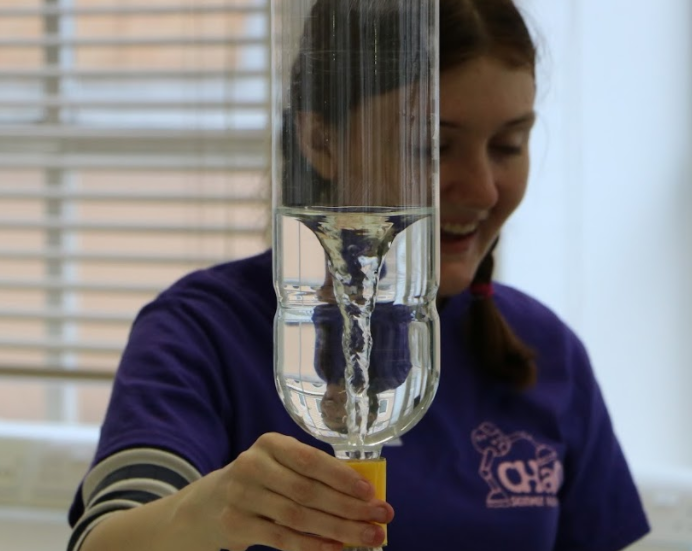
The bowl can be filled with water; a simple vortex forms in it as it empties.
The paddle, moved through the water, sheds vortices from its sides.
The smoke ring cannon makes smoke rings when tapped on the base. These are easily viewed in the cabinet.
*** BASIC PROCEDURE AND EXPLANATION ***
This experiment is about smoke rings, but, to understand why they happen, it's best to start with something simple, like water emptying from a bath. Have you ever noticed what water does when it goes down a plughole? Does it just go straight down? With any luck, your audience will have already noticed that it doesn't, but it's still useful to show them a simple vortex in action using the bowl with a hole in. It's also possible to make a vortex without draining the water away: to do this, persuade someone to drag a paddle through a tank of water. Can you see the little whirlpools falling off the sides? They form because the paddle speeds up the bit of water next to it, so that it's going faster than the bit of water next to that, making the water twist.
So far the cores of our vortices (whirlpools) have been roughly straight lines. It's possible to make a vortex the core of which bends back on itself in a circle. You can spin your hand in the air at this point - this demonstrates how awkward the thing is to describe without a real example! Fortunately, we have one - since air is a fluid, like water, we can make a ring of vortex in it. If we use smoke, we'll even be able to see it. This is what the smoke machine is for. When you tap the base, some smoke gets pushed out of the hole at the top. The sides of the hole in the bucket work like the paddle did in the tank, slowing down the smokey air near the sides more than that in the middle, and making a twisting movement all of the way round. This makes a ring of vortex - can you see how it's rotating?
*** OTHER THINGS TO TALK ABOUT ***
Pipe smokers can make smoke rings, as can volcanos!
vortices in air occur in weather systems. Tornados are a particularly vivid example, but there are big, slow vortices around the size of countries sitting around all of the time, determining the direction of the wind.